
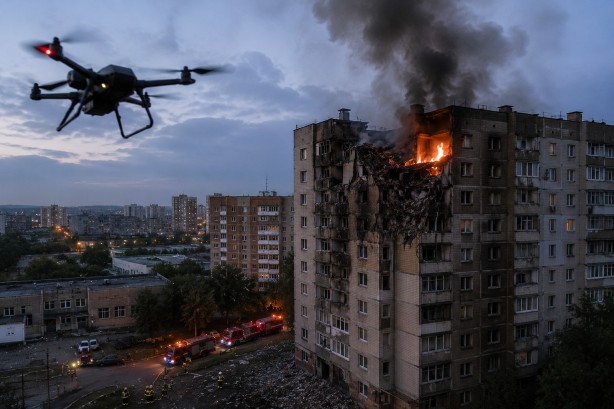
In what is being described as one of the largest drone offensives by Ukraine since the conflict began, Russian officials report that at least six people have been killed, and a significant fire has erupted at a distribution warehouse near Moscow. Russia’s Defence Ministry claims that 1,478 Ukrainian drones were intercepted within a 24-hour period, marking the highest number recorded in a single day; however, these numbers remain unverified. Moscow’s Mayor, Sergei Sobyanin, noted that around 600 drones targeted the Moscow region, with 201 said to have been destroyed, resulting in one fatality.
The Wildberries distribution center near Podolsk, approximately 25 miles south of central Moscow, was severely damaged by a massive fire, rendering the facility, which spans around 250,000 square meters, inoperative according to Ukrainian military reports. Ukrainian authorities say they have increasingly utilized long-range drones to hit Russian military and economic targets far from the front lines, with several facilities linked to Wildberries reportedly targeted for their alleged use in military logistics.
These developments underscore Ukraine’s expanding long-range strike capabilities even as Russia persists in using drones and missiles to attack Ukrainian cities and infrastructure. In Ukraine, Russian strikes claimed at least seven lives, including casualties in Kryvyi Rih and the Sumy region, while a missile strike in Kyiv injured six people and ignited fires at a significant book market, where several businesses reported losing their entire stock.
Meanwhile, NATO reported that a Spanish fighter jet, part of a NATO patrol, shot down a suspected Russian drone that had entered Romanian airspace. Ukrainian President Volodymyr Zelenskyy accused Russia of persistently targeting civilian infrastructure, stating that Moscow launched over 1,550 attack drones, nearly 1,560 guided bombs, and 62 missiles against Ukraine over the past week.
This escalation highlights the increased reliance by both sides on long-range weaponry, heightening the risk of casualties and extensive damage far from the front lines. As the conflict intensifies, the use of such technology underscores the potential for greater destruction and human cost in both countries.