
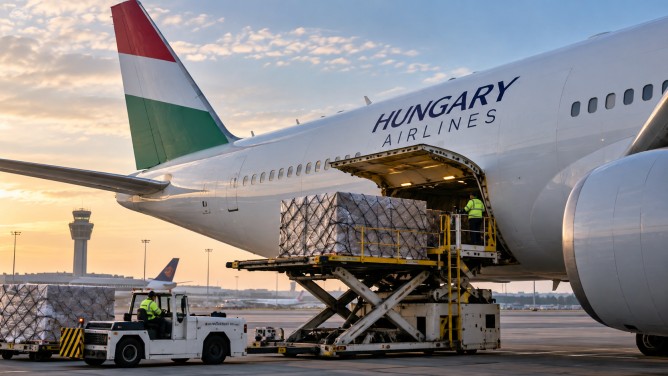
Hungary Airlines is realigning its operations due to shifts in the European air cargo landscape, prompted by a newly imposed €3 customs duty on small shipments that took effect on July 1. This new duty has impacted e-commerce cargo volumes across Europe, initially causing a surge in shipments in June as retailers rushed to dispatch goods before the rule’s implementation. However, July saw a decline in cargo volumes accompanied by longer processing times. While the market is gradually stabilizing, the industry is bracing for an additional €2 processing fee anticipated in November.
Amidst these challenges, Hungary Airlines faced further adjustments when scheduled maintenance for its flagship aircraft, the Airbus A330-243F with the registration HA-LHU, was prolonged due to global supply-chain delays. The C-check maintenance extended until mid-September, with the freighter expected to resume full operations by the end of the month. In response to the evolving market conditions, the airline intends to revise its route network, enhance cargo-handling procedures, and temporarily reduce flight frequencies to optimize aircraft load factors.
The airline’s fleet strategy is also undergoing changes as the second aircraft, an Airbus A330-243P2F registered as HA-ZTO, is set to exit the fleet following its owner’s decision to sell it. Despite this, Hungary Airlines remains committed to expanding its fleet and is actively exploring leasing and growth opportunities to sustain its operations.
Further diversifying its operations, Hungary Airlines is venturing into specialized cargo markets. Commencing in the third quarter, the airline plans to enter the live-animal transportation and temperature-controlled cargo sectors. By employing real-time monitoring, Hungary Airlines aims to offer more specialized services and tap into higher-margin opportunities, broadening its service offerings and adapting to changing industry demands.